Club Oversight Best Practices: A Practical Guide for Sports Clubs
26 November 2026

Club Oversight Best Practices: A Practical Guide for Sports Clubs
Good oversight in a sports club comes down to three habits: the board sets direction and limits, the money is visible to more than one person, and every decision and risk is written down where the committee can find it. Clubs that keep their registrations, payments, attendance and team communication in one system make all three far easier, which is why we built Sidekick for Clubs as a single platform with club-level oversight.
This guide is for team managers, coaches, club administrators and committee members who need a workable routine, not a governance textbook.
TL;DR
- Oversight means the board governs (direction, limits, monitoring) and managers run the day-to-day. It is not second-guessing every decision.
- Split money duties between at least two people, review budget against actuals regularly and keep receipts for everything.
- Keep a short risk register, review it at least once a year and put it on the meeting agenda.
- Record decisions in minutes that every committee member can open, and tell members what was decided.
- Check the legal and safeguarding rules for your own state, league or governing body, since they differ by place.
Table of Contents
- What oversight actually means
- Build the basic structure
- Oversee the money
- Manage risk without drowning in paperwork
- Document decisions and talk to members
- Know your legal duties
- A simple yearly oversight calendar
- Put it into practice with Sidekick
- FAQ
- Sources
What oversight actually means
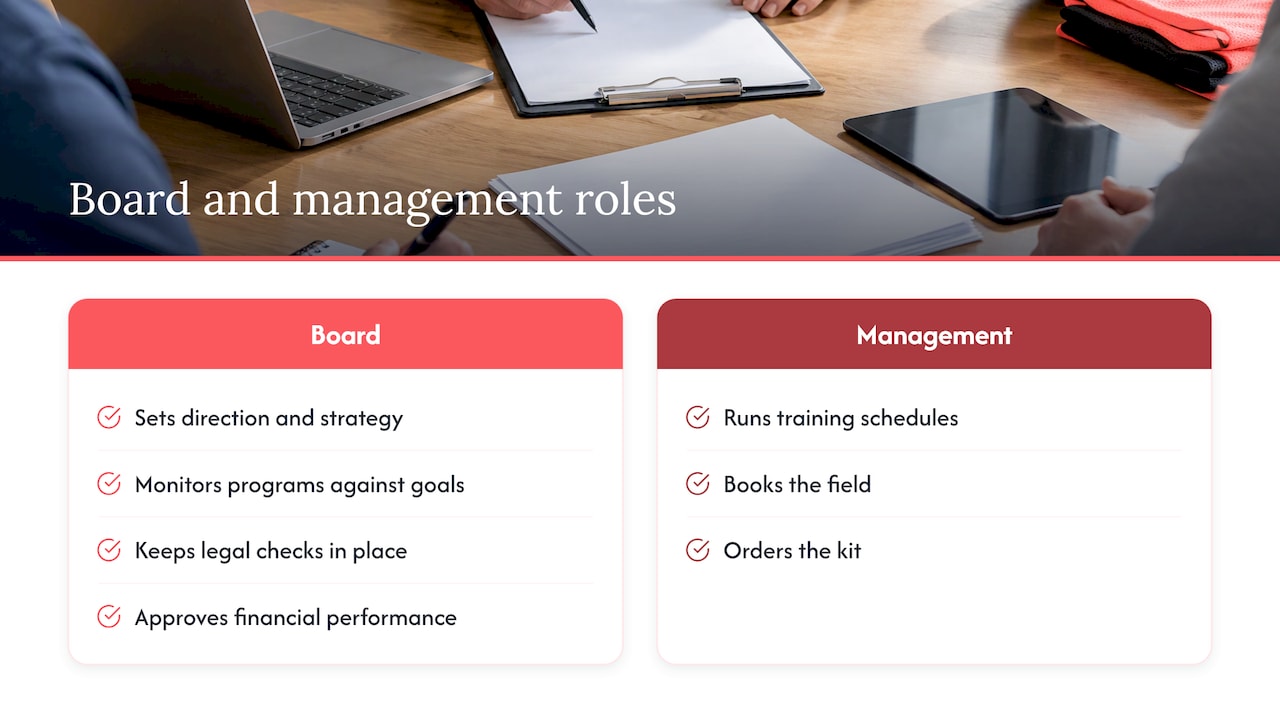
Oversight is not management. A governance guide from Canada Soccer describes good governance as a board that sets direction and strategy, monitors programs against goals, and keeps internal checks in place so the club meets its legal duties and acts in its own best interests. The board governs; it does not run training schedules or order the kit.
The NSW Government’s guidance on boards and committees lists the board’s duties in similar terms: set objectives, define who the chair and executive officer answer to, monitor performance, manage communication with members and sponsors, manage risk, ensure compliance and approve and review financial performance.
In a small club the board and the managers are often the same volunteers. That is fine, as long as you know which hat you are wearing. When you plan, you are governing. When you book the field, you are managing.
Governing without second-guessing
The Canada Soccer guide argues that a board works best as a policy board: it sets limits and expectations, then lets managers act inside them. Its tool for this is an executive limitations policy, which states in plain language what management may not do without board approval. For a club, that can be as simple as one page: spending above a set amount needs two committee approvals, new sponsorship deals go to the board, and everything else is the manager’s call.
Build the basic structure
A few documents carry most of the weight. The Australian good governance handbook from a sports law firm recommends a board charter defining roles and authority, a three-to-five-year strategic plan checked at least annually, performance reviews every six to twelve months and a proper induction for new board members.
For a volunteer club, a practical version looks like this:
- Terms of reference for the committee: who sits on it, how people are appointed, how often it meets and what it may decide. The Rugby League community governance guidance asks for exactly this, plus minutes published to members and conflicts of interest noted at every meeting.
- A one-page plan for the season or year: goals, budget, key dates.
- A short induction for each new officer: the constitution, the plan, last year’s accounts and a conversation with the president.
- A yearly self-review: what worked, what slipped, what to change.
The UK’s Football Club Corporate Governance Code goes further for professional clubs, but its core ideas scale down well: a quorum for meetings, clear roles, good papers circulated in advance, accurate minutes that record dissent, and committees with written terms. It also recommends that the chair and the chief executive be different people so each checks the other. In a small club, that translates to not letting one person both run things and sign off on them.
Oversee the money
Money is where grassroots clubs get hurt most, because it is handled by volunteers with day jobs. The NSW Office of Sport financial management toolkit gives a clear baseline:
- The budget belongs to the board and is prepared at least annually.
- Look at three things, not one: income and spending, cash in and cash out, and the effect on the balance sheet. The toolkit warns that the common trap is assuming cash and spending line up perfectly.
- Use segregation of duties (one person prepares, another reviews), dual signatories, bank reconciliation, limited access and a habit of investigating variances.
Devon Cricket’s financial management FAQs suggest the treasurer drafts the budget with committee input, the committee reviews it ideally every quarter, and a contingency line covers surprises. British Rowing’s club governance guide adds a small expenses policy with clear procedures whenever members are reimbursed, and independent verification or audit of annual accounts unless the club is exempt.
A worked example
A club of eight teams collects registration fees, runs a fines jar per team and sells club hoodies. Without a system, that cash sits in a dozen personal accounts and spreadsheets. A sensible routine:
- Registrations and merchandise payments are collected in one place, not through managers’ own accounts.
- The treasurer reviews a payments report before each committee meeting.
- A second officer approves any payout over the limit the committee set.
- Once a quarter, the committee compares budget to actuals and writes down every large variance.
This is where tooling earns its place. Sidekick lets teams collect registrations, pool gift funds, automate fine funds and track attendance and payments, and clubs can sell kit and merchandise through a club marketplace. Because registrations and payments are tracked in the app, the treasurer sees who has paid without chasing screenshots. Sidekick has no subscription or premium tiers; we take a small cut only when money moves through registrations, gift funds and fines.
Manage risk without drowning in paperwork
Risk management sounds heavy, but the NSW Government’s risk guidance for sporting clubs boils it to a ten-step loop: appoint someone to own risk, identify and audit risks, analyze them, make a plan, communicate it, make risk a recurring agenda item and review at least annually. It names seven categories: compliance, financial, governance, operational, environmental and event, reputational and strategic.
The UK code asks boards to keep a risk register recording each significant risk, its likely impact and likelihood, the controls in place and planned actions, with standing agenda items such as safeguarding, ground safety, cyber security and money owed. The same code frames the goal sensibly: risk cannot be removed from sport, only identified and managed.
A starter register for a volunteer club might have eight to ten rows:
| Risk | Example | Owner | Control |
|---|---|---|---|
| Financial | One person holds all the cash | Treasurer | Dual approval, regular reconciliation |
| Participant safety | Unsafe playing surface | Head coach | Pre-play inspection, incident log |
| Safeguarding | Unscreened volunteers | Welfare officer | Check requirements for your jurisdiction |
| Compliance | Missed annual filing | Secretary | Calendar of deadlines |
| Event | Extreme weather | Event lead | Cancellation plan sent to all members |
| Reputational | Unclear complaint process | President | Written complaints procedure |
BC Sailing’s risk guide makes two points worth copying: tell volunteers that participant safety comes first, and build procedures with the front-line people who see the risks. Share the register with them and brief them on it.
One handbook from a university sport body, the UQ Sport clubs handbook, shows how concrete this gets: annual risk assessments for regular activities, an activity plan lodged two weeks ahead of one-off events, and accident, incident and near-miss registers kept by the secretary and reviewed by the committee. Your own governing body or insurer will have its own version, so ask them for it.
For wider reading on how clubs manage risk and policies across a membership, the guide to board oversight of club-wide risk covers trends boards are facing.
Document decisions and talk to members
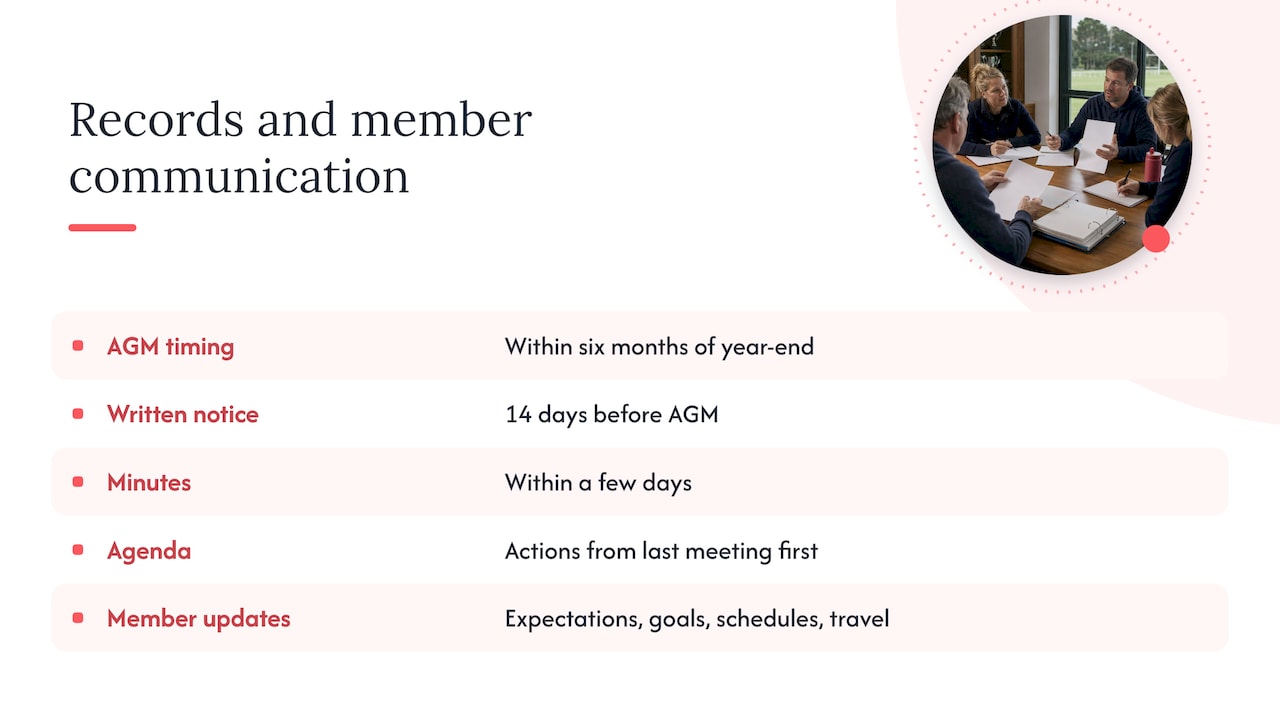
Oversight you cannot prove did not happen. The UQ handbook expects decisions to be recorded in minutes kept where every committee member can reach them, with standard record-keeping for each office bearer, and an annual general meeting (AGM) held within six months of the financial year end with 14 days’ written notice. Those are one university’s rules, but the habit applies anywhere: minutes within a few days, decisions listed separately from discussion, conflicts of interest noted.
The chair’s job, per the UK code, is to monitor progress against agreed plans, budgets and actions, and to run periodic evaluations. Put an “actions from last meeting” item at the top of every agenda and you have done most of it.
Members need to hear from you too. The University of Maryland’s club sports operating manual tells officers to over-communicate about expectations, goals, schedules and travel, across several channels. Scattered group chats make that hard, since half the team misses the message. A single place for schedules, team chat and attendance means players and parents see the same information, and coaches can see who is turning up.
Know your legal duties
Legal duties depend on where the club is. The Australian handbook lists the typical duties of board members: act with due skill and diligence, avoid conflicts of interest, keep proper books, act honestly and for the organization as a whole. Clubs must also meet employment, tax, discrimination and workplace safety law. In the US, your state’s nonprofit rules, your league or national governing body, and your insurer set the specifics. Ask them what your club must file, which background checks apply to coaches and volunteers, and what your policy covers. Insurance, per the handbook, typically means public liability, professional indemnity for coaches, personal accident and directors’ liability.
A simple yearly oversight calendar
- Before the season: approve the budget, update the risk register, induct new officers, confirm insurance and registrations.
- Monthly: review a payments and attendance report, then deal with open actions.
- Quarterly: compare budget to actuals, record variances, review incidents and near misses.
- After the season: present accounts to members, review the board’s own performance and set next year’s plan.
What we think
Most clubs do not fail at oversight because the committee does not care. They fail because the information is scattered: fees in one person’s bank account, attendance in a group chat, fines in a notebook. You cannot oversee what you cannot see.
That is why we built Sidekick around one platform for scheduling, team chat, registrations, payments, attendance and club-level views. A club administrator sees every team in one place, and managers spend their time coaching instead of chasing.
We also believe cost should never decide whether a club can run well. Every feature is free for life. We take a small fee only when money moves, so a club of any size can have the same visibility as a large one.
Mattias
Put it into practice with Sidekick
Sidekick for Clubs brings registration collection, payment tracking, team chat, scheduling, fundraising tools and a kit and merchandise marketplace into one place, with oversight across all your teams. Setup is fast, players, parents and staff each get a role, and there are no subscription fees or premium tiers.

See how it works for your club on the Sidekick for Clubs page, or start with a single team on Sidekick. More guides are on the Sidekick blog.
FAQ
Who is responsible for oversight in a club?
The board or committee is responsible for governing: setting direction, monitoring performance, managing risk and approving finances. Managers and coaches handle daily operations within the limits the board sets. Good governance also needs input from everyone, including volunteers and advisers such as an accountant.
How often should a club committee review its finances?
At minimum, the board approves a budget each year and reviews accounts before the AGM. Many clubs review budget against actuals quarterly and look at management accounts at every meeting. Any large variance should be written down along with the reason.
What should a basic club risk register include?
For each significant risk: a description, its likely impact and likelihood, the controls in place and the planned actions, plus an owner. Review it at least annually and make risk a standing item on committee agendas.
How do we keep players and parents informed?
Use one channel for schedules, changes and announcements, and repeat key messages across more than one medium. Publish committee decisions to members. A team app with chat, scheduling and attendance keeps everyone looking at the same information.
Sources
- Canada Soccer Governance Guide
- NSW Government: Boards and Committees
- Good Corporate Governance handbook
- Rugby League Community Game Governance Guidance
- The Football Club Corporate Governance Code
- NSW Office of Sport Financial Management toolkit
- Devon Cricket Financial Management FAQs
- British Rowing Club Governance Guide
- NSW Government: Compliance and risk management
- BC Sailing Risk Management Guide
- UQ Sport Affiliated Clubs Handbook
- University of Maryland Club Sports Operating Manual
- Board oversight of club-wide risk